
Our Approach
Making the complex clear
Organizational life may be ubiquitous, but it is not a natural act. Humans are hard wired for the tribe; everything more complex is a stretch. We should not be surprised when goals get lost in implementation, when personal agendas undermine corporate intention, or when documented procedures have no relationship to how work actually gets done. And as organizations and the problems they face become more and more complex, the challenge of getting things done only becomes greater.
After over 450 client engagements, I have come to understand some of the basic principles behind organizational success. At least I think I have; this site is designed so you can make your own judgment. The notes below expand on the most critical themes in my approach to improving organizations.
 An organization is a complex entity, encompassing
at least 3 different facets or layers that are only loosely integrated
with each other.
An organization is a complex entity, encompassing
at least 3 different facets or layers that are only loosely integrated
with each other.
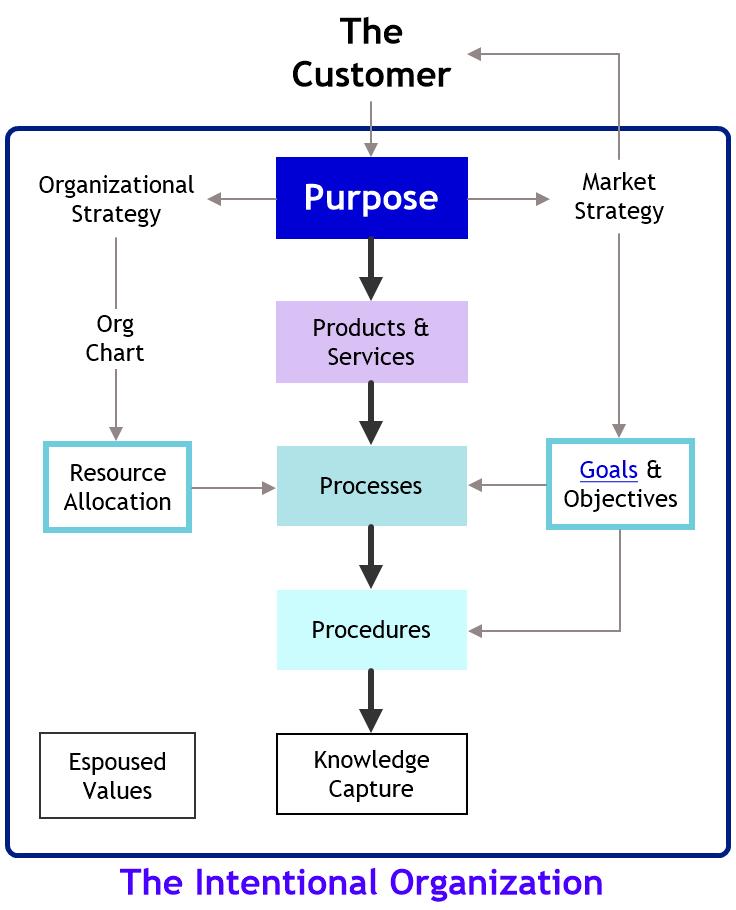
Part of the organization is INTENTIONAL. We design organizations to achieve a specific end. We want to deliver a product or service, serve a customer segment, or to exploit a particular technology. The organization is deliberate, rational, and structured. This intention is articulated through a vision and mission statement, a strategic plan, designed work processes, and concrete procedures. It is echoed in the organizational structure, the IT infrastructure, and even the physical plant. The intentional facet also includes the desired values needed to support the purpose of the organization.
This component of organizations is relatively static, changing only periodically. It is often captured in documents that can survive for a long time.
It contains the conceptual backbone of the company. It starts with the purpose or vision of the company, which (hopefully) reflects a deep understanding of the customers' needs and interests. That purpose is translated into the products and services the company provides, which then requires the design of the work steps that will deliver on that promise. From those process definitions, the organization fleshes out the specific procedures that will express the process design in the current time and circumstance. Those procedures are captures in documentation and training.
The purpose of the organization also drives its organizational strategy as well as its marketing strategy. The organizational strategy will define the organizational chart and the general approach to allocating resources (headcount, budget, etc.). The marketing strategy will determine the goals and objectives that will drive performance.
All along the operation of the company should reflect its espoused values. It is not automatic that those values will, in fact, show up in the company culture, but that will take us to another layer.
 Part of the organization is BEHAVIORAL. It bursts
into existence only
when staff walk in the door (or login to Zoom) and start to talk
and act. This component of the organization
is fluid, dynamic, and reacts to every staff change.
Part of the organization is BEHAVIORAL. It bursts
into existence only
when staff walk in the door (or login to Zoom) and start to talk
and act. This component of the organization
is fluid, dynamic, and reacts to every staff change.
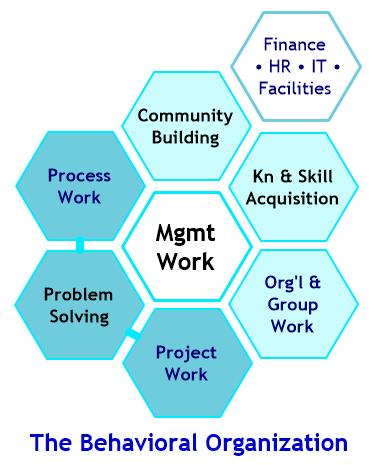
Here we can only catalog the various ways people act in organizations. Process work is the repetitious actions inherited from the intentional organization. Project work, in contrast, is the one-time efforts to design new products, solve problems, or orchestrate change efforts. And some actions are solely in service of relationships and community. Workers also spend time acquiring new knowledge and skills for more generative work. And there is also effort spent on the internal structures of the organization. Staff attend team building retreats, struggle through re-organizations, or sit through informational meetings on new company initiatives.
Both process work and project work involve problem solving. This is the essential tool for refining operations, responding to a shifting environment, addressing novel situations, or any other circumstance requiring actions beyond the formally stated structures or policies of the organization.
This facet of the organization is ideally directed by the intentional structures; the whole purpose of policies, plans, job descriptions, organizational charts, and the like is to shape and target of behavior of staff. But actual behavior often diverges from organizational inentions in a variety of ways. Personal agendas corrupt strategic priorities. Ego and poor soft skills distort desired working relationships. Cultural themes collide with formal structures. A team charter stumbles in the face of sour history of team members. Since there is never a one-to-one correspondence between prescriptions and behavior, some time is required by managers to oversee, direct, counsel, or constrain staff actions.
 Part of the organization is ORGANIC. It is the
culture that emerges
from the thousands of conversations, glances, gestures, and grimaces
that pass between
employees everyday. It is the storehouse of tribal knowledge that
may (or may not) reinforce the more intentional job definitions
and documented procedures. It is the informal networks of respect,
affection, and connection that complement (or sometimes negate)
the organization chart. It is the lived values and norms that
may be quite discrepant from the desired values from the intentional
organization. It is the capacity to absorb change and
uncertainty.
Part of the organization is ORGANIC. It is the
culture that emerges
from the thousands of conversations, glances, gestures, and grimaces
that pass between
employees everyday. It is the storehouse of tribal knowledge that
may (or may not) reinforce the more intentional job definitions
and documented procedures. It is the informal networks of respect,
affection, and connection that complement (or sometimes negate)
the organization chart. It is the lived values and norms that
may be quite discrepant from the desired values from the intentional
organization. It is the capacity to absorb change and
uncertainty.
This component of the organization is more elusive, only visible sporadically. It reveals itself in behavior, feeling, and unconscious beliefs. It is not responsive to executive command or even collective intentions. It can be influenced, but not designed or manipulated. Although it has a thousand faces, the organic side of an organization grows out of how well several dilemmas are addressed:
- Work outputs /\ Making meaning: Do we want to be productive? Or do we need to find meaning in life? The obvious answer is "Yes... to both!", but we are often forced to choose.
- Task requirements /\ Relationships: Should I stay within my role? Or should I do what it takes to build a good relationship? Once again, the best answer is "Yes", but the more common pull is to pursue at the expense of the other.
- Prescription /\ Performance: Certain levels of output are often specified, and then we are faced with the reality of actual performance. Does the gap lead to recriminations and punishments? Or does the shortfall lead to curiosity and learning? How organizations respond to errors shapes the culture.
- The Position /\ The Person: In the organization you might have a job title and a position in the hierarchy. But in your personal life you belong to a book club, a political party, struggle with diabetes, a faltering marriage, a difficult financial situation, or an obvious in-law. Can you bring your personal life into the office? Or do you have to pretend to be "professional" dispite the human turbulance inside?
- Design in Parts /\ Executive as a whole: We build organizations job by job, team by team, department by department. We write policies, protocols, and documentation. But organizational life flows out as an organic whole, with complex interactions and unanticipated consequences.
These tensions (and how they are managed) permeates the organizations and structures the emergent culture of the organization. The company's approach to these tensions gives rise to informal networks, provides stories of heroes and villains, determines feelings of trust, and all the other manifestations of the interface between the intentional and the human facets of the organization.
Process Improvement would seem to be a well-developed field with plenty of advocates and adherents. My experience is that much of modern process improvement is off the mark. The original intent was to empower the front line worker; nowdays it seems more common to automate the work and replace the front line expert. So the business analyst becomes the new supposed locus of wisdom.
The most common approach to defining work is to focus on procedures, which are a pale shadow of a robust process definition. The design of work should be anchored in a promise to a customer to deliver the product or service that helps them achieve the benefit they desire. A process is also defined by the inputs and enabling resources we marshal to support the work. Work that creates products and services is always paired with review work, which compares actual output with the desired quality. Generative work is fundamentally different from review work.
I have gathered the lessons of my years of practice into a book-length monologue, which you are welcome to download by clicking here..
These are the important elements of a process definition. The particular procedures we deploy to fulfill that promise should be the most flexible part of work design. The procedures should never be mistaken for the essence of a process; they are, in fact, the least stable feature of a process.
Our approach is to characterize the work in ways that make its structure and challenges visible to those who know it best, and thereby give front line staff a venue for making improvements that managers, stakeholders, and IT staff would typically miss.
Problem
Solving
Problem solving is marred in this culture by a simplistic approach that is so deeply embedded it is difficult to even see how it undermines our best intentions. The problems we face in business today are more conflicted, more complex, and more varied than even 50 years ago. Yet we continue to apply a linear, "one-size-fits-all" approach. Faced with challenging problems, it is no surprise that our focus falls on the problem itself. But we often fail to distinguish between the symptoms that bother us vs. the underlying cause of our distress. In a complex entity like an organization, the cause can be far distant from where the symptoms erupt into view. And we are so obsessed with results that we often skip right ahead to solutions. We scan best practices or off-the-shelf solutions rather than deeply explore the problem itself. What passes for "problem solving" is often just negotiating solutions.
Our approach is built on a problem solving model that posits that there are only 6 types of problems in the world (For more detail). The most critical question is not "What's the best solution?", but rather "What type of problem are we facing?". Each problem type has its own unique discovery process as well as its own unique solution template. The strategy that will likely resolve some problem types turns out to be wholly inadequate for other problem types.
Those who look to leaders expect them to be "in control", to see through to the next level. But those who lead are often frustrated at their inability to direct the organization effectively, or even to see clearly what the next steps should be. Any reasonably large organization has its own momentum, its own organic integrity. It can be poked and prodded, but not controlled. Informal communication networks and corporate cultures mean that executives don't run the company, they ride it.
The new rules for leading or managing are different than the traditional "command and control" approach. They require attending to the organic evolution of the firm rather than designing and directing it. The business world is littered with leaders who tried to direct an organization without first winning it over.
The mantra of the MBA graduate may be to plan, direct, monitor, and control. But real organizations are more responsive to heart, integrity, and courage. Supposedly leaders should posit the vision that galvanizes the organization. But the real challenge is getting everyone to think with the vision, which requires something more than persuasion and structured rewards. Profitability may be the outcome for which the corporation is created, but the most direct path to improved outcomes is to focus on how people think and how they make sense of their situation. Rewards can shape behavior, but only relationships can impact how people think.
Copyright © 2020
Jerry L. Talley
Rancho Cordova, California
(650) 967-1444